Buyer's guides · Timeline
How long does commercial solar take from first enquiry to switch-on?
From first call to switch-on: what takes weeks, what takes months, and where grid connection fits.
 Written by Harry HainesCEO & Co-Founder, CH Group
Updated · 8 min read
CH Group runs controlled solar tenders for commercial sites of 100 kWp and above.
The short answer
A straightforward commercial rooftop system usually takes 2 to 4 months from first enquiry to switch-on, and 3 to 9 months where the local grid is constrained 1.
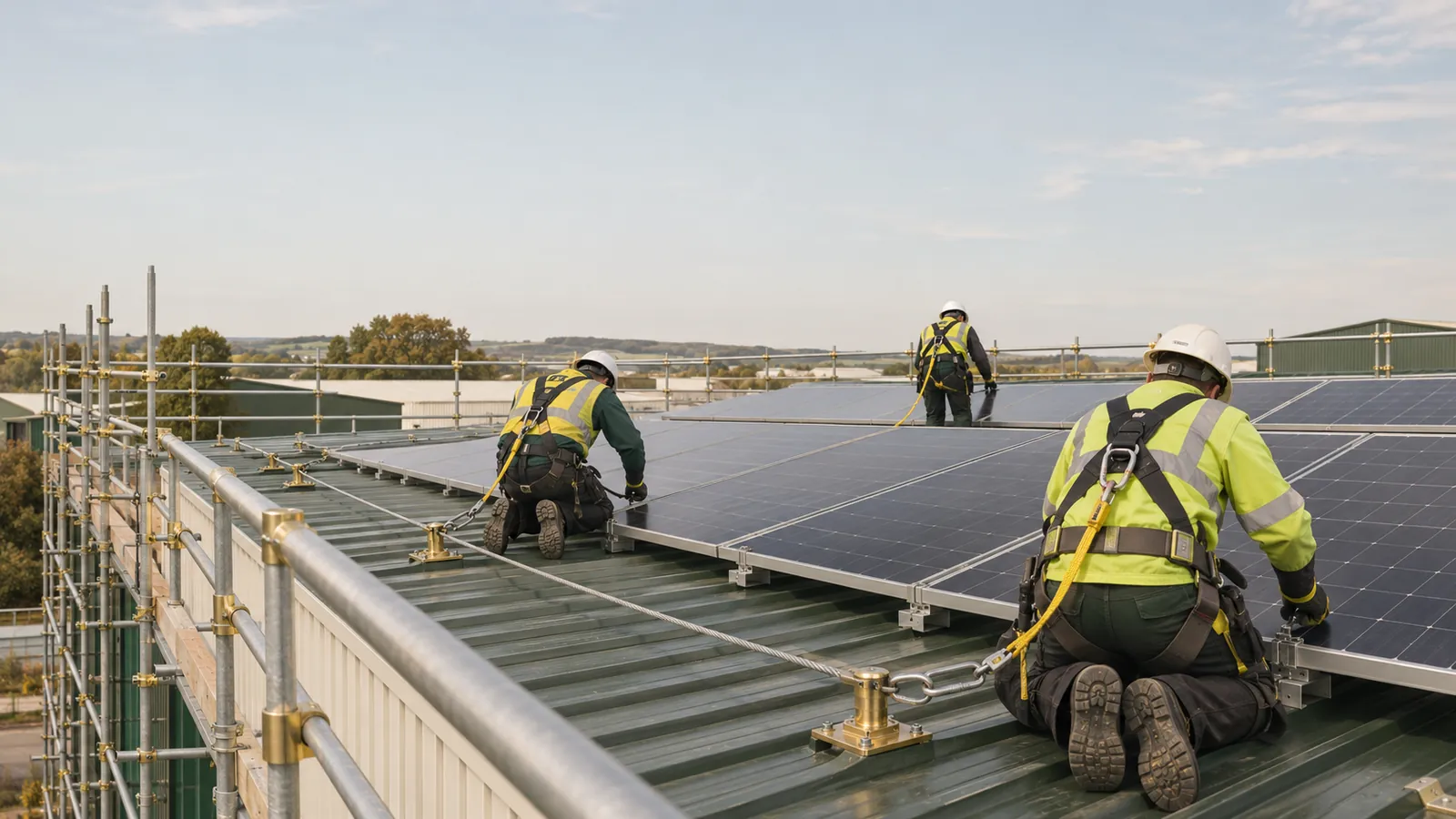
The work on the roof takes 1 to 3 weeks for systems of 100 to 500 kWp 1. The longest step is usually the grid connection application to the distribution network operator (DNO), known as G99. Ofgem standards give the DNO 45 working days to issue an offer where only low voltage works are needed, and 65 working days where high voltage works are involved 2.
Figures checked
Key numbers
| Figure | Source | |
|---|---|---|
| Whole project, straightforward site | 2 to 4 months | EvoEnergy, updated 31 Aug 2026 |
| Whole project, constrained grid | 3 to 9 months | EvoEnergy, updated 31 Aug 2026 |
| DNO offer standard, low voltage works | 45 working days (about 9 weeks) | SSEN, April 2026 |
| DNO offer standard, high voltage works | 65 working days (about 13 weeks) | SSEN, April 2026 |
| G99 in practice | 4 to 12 weeks, or 3 to 6 months on a congested network | EvoEnergy; Zigaflow, 3 Jul 2026 |
| Install, 100 to 250 kWp | 1 to 2 weeks | EvoEnergy |
| Survey to contract award, Kelston Sparks (116 kWp) | 22 days | CH Group project |
What goes wrong, and what does it cost?
The usual timeline mistake is to treat the date the installer quotes for the roof work as the date the system switches on, when the grid connection decides it.
The board approves a project on the promise of a summer start. Then the DNO offer arrives weeks after the date the installer planned around, and the switch-on date moves with it.
Five mistakes cause most of the slippage:
- Applying for G99 late. Installer guidance is to submit early, ideally before the customer accepts the quote 3. A late application delays every stage that waits for the offer.
- Ordering equipment before the DNO offer. Commercial inverter lead times run 4 to 8 weeks 3. If the offer changes the design or caps export, you hold the wrong equipment.
- Incomplete application documents. Missing documents stall a G99 application at initial review 3.
- Hidden roof and site work. Roof repairs, structural strengthening and switchgear upgrades are common causes of delay 1. A listed building can add an 8-week planning application 3.
- Assuming national grid reform applies. Rooftop schemes under 5 MW export in England and Wales usually sit outside the Gate 2 reform 94.
The cost is lost generation. A system that switches on three months late forgoes three months of savings, which is why the order of the stages matters more than the length of any one stage.
What are the stages from enquiry to switch-on, and how long does each take?
A commercial solar project runs through survey, design, tender and contract, G99 application, procurement, installation and commissioning, and the DNO sets the pace for one of those stages.
Installer sources give the ranges below. They are typical figures, not promises, and several stages can run side by side. Design can run alongside the DNO review.
| Stage | Typical duration | Who sets the pace | Best for / watch for |
|---|---|---|---|
| 1. Data and site survey | Not published by a public source | You and the installer | Start with twelve months of half-hourly data. Watch for roof condition problems found here. |
| 2. Tender and contract | Kelston Sparks: 22 days from site survey to contract award | You, once proposals are comparable | Best for buyers who hold one brief and comparable bids. Watch for decisions that stall. |
| 3. G99 application and DNO offer | 4 to 12 weeks typical 1; 3 to 6 months on a congested network 3; standard 45 or 65 working days 2 | The DNO | Submit early with every document. Watch for network reinforcement. |
| 4. Procurement | 2 to 6 weeks 1; inverters 4 to 8 weeks 3 | Installer and suppliers | Order after the offer is known. Watch for supply delays. |
| 5. Installation | 1 to 2 weeks at 100 to 250 kWp; 2 to 3 weeks at 250 to 500 kWp 1 | Installer | Best for sites with a ready roof. Watch for roof repairs and over-cladding. |
| 6. Commissioning and DNO permission to operate | Not published by a public source | Installer and DNO | Export limits are tested at commissioning 5. |
Does my business need a G99 application or a G98 notification?
A business with a system of 100 kWp or more needs a G99 application, because G98 notification covers only very small systems, and the DNO must approve a G99 system before it is installed.
G98 is a notification made after a small system is installed. G99 is an application made before installation, followed by a DNO offer and commissioning.
The sources disagree on the exact threshold, so we give both:
- SurgePV, an installer source, puts the split at 16 A per phase of inverter output, about 3.68 kW single phase or 11.04 kW three phase 5.
- SSEN, a DNO, says generators of 50 kW or less are micro-generation connections, and that from 50 kW you submit a G99 application before installation 6.
Either way, a 100 kWp roof is a G99 project. The Energy Networks Association's G98 and G99 documents set the rule, so confirm the threshold that applies with your DNO.
G99 projects are grouped by capacity. Type A is below 1 MW, Type B is 1 MW to under 10 MW, Type C is 10 MW to under 50 MW and Type D is 50 MW and above 7. Most rooftop systems of 100 kWp to 1 MWp are Type A.
How long does the DNO take to issue a G99 offer?
The DNO has 45 working days to issue a connection offer where only low voltage works are needed, and 65 working days where high voltage works are involved, and in practice a G99 often takes 4 to 12 weeks.
SSEN's April 2026 standards set 45 working days for a generation offer needing low voltage works and 65 for high voltage works 2. If the DNO misses them, it pays you £85 per working day for the low voltage case and £180 for the high voltage case 2. Ofgem set these sums from 1 April 2026 8.
These are late-payment triggers, not promises of speed. They apply to new or modified connections, and to existing connections only where a new service connection is needed 2.
Public sources do not agree on one number. Zigaflow, a trade source, says up to 65 working days for any G99 and 3 to 6 months on a congested network 3. EvoEnergy says about 4 to 12 weeks 1. Plan for the range, and treat the DNO as the step you cannot compress.
Export limitation can reshape it. A DNO can cap your export as a G99 condition, and the cap is tested at commissioning 5. Limiting export can avoid some network reinforcement, though the sources do not say how often.
What delays a commercial solar project, and who is this timeline not right for?
Roof work, grid constraints, equipment supply and planning cause the delays, and a buyer who needs power from a fixed date should build in the 3 to 9 month constrained case.
Roof condition is a common cause, and one you can check early. Merlin Diesel Systems took 8 weeks for a 278.5 kWp system, against the 2 to 3 weeks EvoEnergy gives for systems of 250 to 500 kWp 1. The 8 weeks covered combined solar and roofing works, including a 41,000 sq ft full roof over-cladding. See the site suitability guide for roof checks.
Grid constraints are the other main cause. A congested network can turn a 4 to 12 week G99 into 3 to 6 months 3.
This timeline suits businesses that can decide within weeks and own or control the roof. It is not the right plan if:
- you need a hard switch-on date inside 8 weeks and the roof needs repair;
- your landlord has not consented yet;
- you already hold comparable quotes and a trusted installer, in which case a tender adds time and little else.
Illustrative example
A 300 kWp roof, stage ranges added up
Take the EvoEnergy ranges for a 300 kWp system 1 and add them as if each stage waited for the one before. Real projects overlap some stages, so this is the cautious reading.
- G99 application and offer: 4 to 12 weeks.
- Procurement: 2 to 6 weeks.
- Installation at 300 kWp: 2 to 3 weeks.
- Total: 8 to 21 weeks.
- Add about 3 weeks for survey, tender and contract, as at Kelston Sparks, which took 22 days from site survey to contract award.
That gives 11 to 24 weeks, about 2.5 to 5.5 months: overlapping EvoEnergy's 2 to 4 months for a simple site and the lower half of its 3 to 9 months for a constrained one 1.
The G99 step accounts for 4 to 12 of the 8 to 21 weeks. The roof work is the smallest block.
Your next steps
Gather your data before you ask for quotes Get twelve months of half-hourly data from your supplier and confirm who owns or controls the roof. Installers need both for feasibility, and missing items stall the start.
Ask each installer when it will submit the G99 Require the application early, ideally before you accept the quote, with every document included. Ask which DNO covers your site and whether export limitation is likely.
Do not order equipment until the DNO offer is known Make the contract conditional on the offer, so a changed design or export cap does not leave you holding the wrong kit.
Check the roof first Ask for a roof condition check at survey. Repairs or over-cladding add weeks, and they are cheaper to find early.
How CH Group handles this
A solar timeline is hard to defend to a board when every installer gives a different date.
We start with twelve months of half-hourly data, then run one controlled tender to our panel of vetted installer partners. Every proposal is compared on the same ten variables, and programme is one of them, so the dates are on the same basis. Kelston Sparks (116 kWp) went from site survey to contract award in 22 days and was installed in 1 week. Plastic Engineering Solutions (150 kWp) was installed in 2 weeks. Merlin Diesel's 8 weeks covered solar and a 41,000 sq ft full roof over-cladding together. All three ran with zero downtime. See the projects.
Questions buyers ask next
Can we start installing before the DNO approves?
Under G99 the application and offer come before installation, so the answer is no for a system of this size. Ordering equipment early is the related risk: the offer can change the design or cap export. Make orders conditional on the DNO offer.
Will the national grid connections reform delay our rooftop solar?
Probably not. Ofgem's April 2025 decision put smaller generation connecting at distribution out of scope of the Gate 2 reform. SolarSurveys, a lead-generation site, puts the threshold at 5 MW export in England and Wales and lower in Scotland, so confirm with your DNO.
What happens after we sign?
The installer submits or confirms the G99 application, orders equipment once the offer is known, installs over 1 to 3 weeks and commissions the system. After you accept an offer, SSEN says it contacts you within 7 working days where low voltage works are needed to agree works dates. Ask your installer who owns each step.
Can a G99 application be refused or changed?
A DNO can attach conditions, such as an export cap, which is tested at commissioning. Where the network is weak, reinforcement works can extend the programme. We found no public refusal statistics.
How long does grid approval take in Ireland?
ESB Networks says a connection offer for small scale generation (above 50 kVA three phase, up to 200 kVA) averages 8 to 10 weeks, longer if complex.
Sources
Public figures are from the sources below, as published on the dates shown. CH Group project figures are projections supplied for each case study. This guide is general information, not financial, tax or legal advice.
- EvoEnergy, What to expect during a commercial solar power installation project, Updated 31 Aug 2026.
- SSEN, Metered Connections GSoPs (performance standards 2026), April 2026.
- Zigaflow, How to quote and run a commercial solar PV installation, 3 Jul 2026.
- SolarSurveys, Grid connections reform and solar, Updated 21 Oct 2026.
- SurgePV, G98/G99 UK regulatory guide, Updated 26 May 2026.
- SSEN, Generation connections, undated.
- SSEN, G99 process post acceptance (flowchart), undated.
- Ofgem, Adjustments to the Guaranteed Standards of Performance prescribed sums (letter to DNOs), 13 Mar 2026.
- Ofgem, Summary Decision Document: TMO4+ package, 15 Apr 2025.
- ESB Networks, Small scale generation, undated.